|
|
you're a legend!by Laura Poggiani
|
|
|
you're a legend!by Laura Poggiani
|
|
Sometimes the popularity of a public figure transcends
simple success and becomes a veritable myth, a phenomenon accentuated in
recent times by both the relentless media frenzy and the crisis of values,
but which nevertheless goes beyond this reductive vision: ordinary people
tend to identify with the mythologized star, experiencing their emotions
and struggles firsthand, as recently happened with the unfortunate
Princess of Wales, or simply reevaluating and exaggerating the public
figure, making them a role model to follow and imitate, especially in
appearance but also in gestures, as was the case with James Dean, for
example. But what characteristics must a figure possess to rise
from the simple position of star to the more ethereal and unbreakable
status of "myth"? Undoubtedly, at least
three fundamental factors: charisma transgression originality
An untimely passing, preferably at the peak of one's
career, will forever immortalize one in the collective imagination, erasing
one's flaws and highlighting only one's virtues, even if they are few. Be
careful: "passing" doesn't necessarily mean premature death, but
rather a retreat from the scene, renouncing one's role as a public figure, but
without completely abandoning one's fans, who, at regular intervals, will still
receive news of their idol (this is the case, for example, of Mina or, more
extreme, of Greta Garbo). Added to all this, of course, is the constant barrage
of media, especially television, which constantly reminds us of old myths or
creates new ones, regularly informing us of their movements.
But what are the astrological signs of a myth? First of
all, a strong Neptune. This planet, in fact, is connected both to the media,
especially film and television, and to the neuroses that often afflict these
characters and, yet, also make them so captivating. Neptune is joined by a
strong Pluto, especially in aspect to the Sun, which provides the charisma
without which it's almost impossible to make a lasting impression on others. Not
to mention that their disappearance is usually Plutonian, too: whether violently
or simply by choosing to retreat into private life, the constant throughout all
these characters is the aura of mystery that surrounds them and encourages the
spread of the wildest theories (such as the alleged fake death of Elvis Presley,
who, some would argue, was actually enjoying the Caribbean sun, or the
intervention of the secret services in a veritable international intrigue
surrounding the death of Princess Diana). Added to all this is a hint of
Aquarian or Uranian values, underscoring a tendency toward transgression and
originality. The astrological correspondences, however, don't stop
at these superficial considerations but, on the contrary, become even more
specific when analyzing the artistic field of the characters in question. Take,
for example, music. First of all, the correspondences between the then-known 7
Planets and the 7 musical notes have been known since ancient times: therefore,
the aspects that link two Planets to each other inevitably give rise to the
union of two musical notes in such a way that, in practice, one could write a
personalized "astrological" song using all the components of one's own
chart. If we then consider that the 12 Zodiac Signs, in turn, are also connected
to very specific notes, it will be easier to understand why one's vocal timbre
always focuses on a very specific note, called "tonality," and not on
another. A very banal example: the song that made Lucio Battisti famous to the
general public is undoubtedly "La canzone del sole," and it is well
known that this song, the first one learned in guitar lessons, focuses on the A
chord progression, a note that, coincidentally, is precisely the one associated
with the sign of Pisces, as Battisti is. But it's especially interesting to note
how the three slow-moving planets are associated with three very specific
musical genres that, in effect, determine the style and genre of the singer in
question: Uranus is associated with rhythm, such as beat, swing,
and syncopated rhythm in general. However, it primarily indicates interpretive
ability, rather than the creativity of one's vocal production; Neptune is associated with melodic music. It also
indicates creativity; Pluto, due to its connection with "the Underworld,"
could only be associated with rock, hard rock, and heavy metal—that type of
music known as "devil's music." Let's now look at some examples of musical myths. Elvis
Presley
He is undoubtedly one of the most enduring legends of
our time. His style was characterized by a great versatility that saw him as
both a standard-bearer of rock 'n' roll and of the melodic genre, but
undoubtedly it is the former that has defined him most, giving rise, even in
Italy, to many of his counterparts, from Little Tony to Bobby Solo, who copied
his style and hairstyle, to Adriano Celentano who, conversely, copied his moves,
especially in the early days of his career, earning him the nickname
"molleggiato," just as Elvis was called "The Pelvis" (an
anatomical part associated, coincidentally, with Scorpio, and in this chart,
Pluto, lord of the sign, is located in the VIII sign, co-signifying Scorpio),
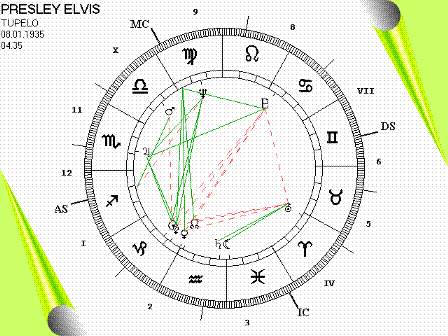
for his now ultra-famous move. First of all, the predisposition for singing is clearly
indicated by the stellium, which includes the Sun and Venus, as well as Mercury,
in the 2nd House, which is connected precisely with this artistic activity. But
above all, Pluto (rock) stands out, opposite the Sun and in the 8th House and in
a sextile aspect to the Midheaven (professional success), and Neptune, also in a
trine aspect to the Sun, as well as placed in the 9th House (co-significant of
Sagittarius, of which, together with Jupiter, it is the ruler), "regulator"
of the Moon, which is placed in Pisces, its domicile, and in a square aspect to
the Ascendant, and placed precisely in Sagittarius! It is precisely this very
strong position of the extremely stimulated Planet Neptune that launched
Presley's name into the firmament, erasing the last years when, ill and prey to
psychotropic drugs (Neptune again!) he was now unrecognizable, to crystallize
the public's attention on that wonderful, extremely ductile voice, which could
be tender and sweet as in "Love Me Tender" or suddenly scratchy as in
"Jailhouse Rock", oscillating, like him, between his Pluto side and
his Neptune side. Lucio Battisti
Here's an Italian legend, retired from the scene by his
own choice and brought back to the attention of the public, always hungry for
information—albeit scant—about him, by a popular television show that
sparked a veritable manhunt. While it undoubtedly created some disruption in the
singer-songwriter's once-quiet life, it certainly had the merit of reviving his
popularity, somewhat tarnished by his latest album flops and the overwhelming
success of his Audio 2 clones. His songs are now immortal, and it's striking
that Lucio Battisti was born the day after another great Lucio: Lucio Dalla. In
addition to the name and the zodiac sign of Pisces, he also shares a remarkable
vocal versatility, so much so that, especially early in his career, Battisti's
vocalizations in various keys became famous. These vocalizations also
characterize Dalla, and Dalla has now perfected them to the point of competing
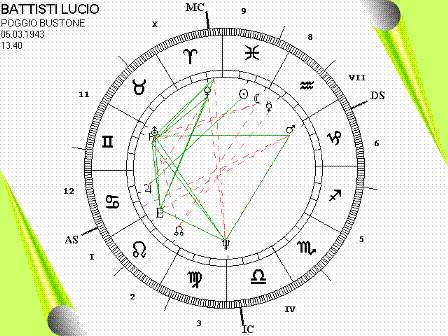
with tenors of the caliber of Pavarotti. But let's get back to our man. Pisces, with a highly
stimulated Neptune, even opposed to the MC, in addition to once again
characterizing the extremely popular impact of his character, makes his genre
predominantly melodic, even if that Pluto in 1st has given a slight nod to much
more rock-oriented songs, such as "10 HP". It is precisely this Pluto,
opposed to Mars in 7th (the Others), which, combined with the Cancer Ascendant,
has forced the subject to exit the scene due to a sort of idiosyncrasy towards
his own audience (his live concerts have always been very few, at least as much
as his television appearances). John Lennon
It's fair
to say that Lennon was a double legend: first with the other members of the
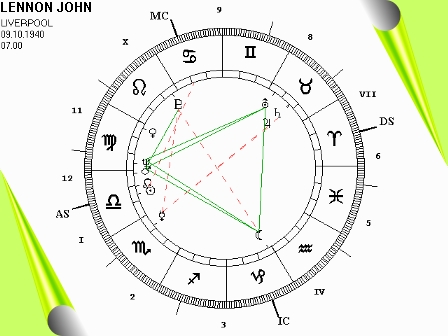
Beatles, then alone until his tragic death in New York. A highly energized Uranus, even one of the vertices of
the Grand Earth Trine that also involves the Moon, amply explains the early days
of his career when, with the Beatles, he became a standard-bearer of the
"beat generation" with songs like "Love Me Do" and
"Paperback Writer." For its part, Neptune, equally energized being in
the 12th House—the counterpart of the 12th Sign that Neptune rules—is the
other pole of the same Grand Trine just mentioned, and equally well explains the
second, more mystical and melodic period of his career, with songs like "Imagine"
and "Jelous Guy." That Uranus in the VIII house exhaustively explains the
sudden and violent death, just as the opposition Saturn-Jupiter to Mercury,
ruler of the IX house, the outside, indicates well the place where it occurred.
by Laura Poggiani - All rights reserved
|